dreams

This category contains posts relating to dreams members of SubtleRealm.org have had.

The Lasting Effects of Dreams

Every so often a dream makes such an impression on me that I take the feeling along with me through the rest of the day; sometimes even a few days, if it was really impressive.

A few weeks ago I remember becoming fairly conscious in the middle of a dream where this "bad guy" alien was shooting up the downtown of a major city with his laser guns and blowing stuff up (I think I had watched a Star Wars movie that night).  Everyone was running scared away from him.  My first reaction was also to get scared and run in the opposite direction, but due to my semi-conscious state, I stopped myself and reminded myself, "Wait, wait... I'm in a dream!"  Then I realized I didn't like the dream because all of the people in the city were scared.  I became indignant with the alien, thinking aloud, "Why are you scaring people? There is no need for them to fear! We're just in a dream!"  And I became determined to stop him, no matter -and not knowing- what might happen.  So I ran towards him and held him in my grip and didn't loosen it one little bit.  As I was running towards him, however, every step filled me with more uncertainty about the outcome, but at the same time more determination to see it through.  I awoke and spend the rest of the day with a greater degree of fearlessness and of compassion towards others than I had felt for quite some time.  

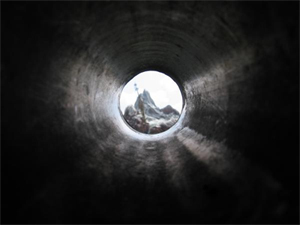
In a more recent dream I was hiking up mountain at night along a winding road.  It was difficult and cold and a few cars passed by me without noticing me at all.  I wondered if I should keep going, but didn't stop.  I don't remember what happened at the top, but I clearly remember coming back down.  I became light-footed and began almost gliding down the mountain side.  Then I heard a whisper saying to me, "That's right.  Don't be afraid. Run along the path before you!" And I began to run faster and faster, and my vision became tunnel-like and there was a veritable light at the end of the tunnel.  It was daytime down at the bottom of the mountain,  This feeling of faith and/or trust in focusing on what is before me and advancing enthusiasticlly and without fear still feels very real to me.  

With examples like these two, I feel like saying that sometimes I learn and grow more from dreams than from real life.  Certainly episodes require less time in the subtle world than in the physical, so that might account for it.  But nonetheless, they are real experiences and the lessons drawn from them are just as valid as those drawn from waking life experiences.  

Glossary Terms: 

Sleepwalking: Dear Science, How is it Done?

I have a question that I am hoping science can answer one day. If scientists are studying our sleep patterns and how to predict whether we can remember dreams, then I would sincerely like to add this to their to-do list. 

You don't have to do much research to find some pretty hair-raising stories about sleepwalking. And this makes the word 'sleepwalking' a sort of misnomer, doesn't it? What I mean is, people do all kinds of things while they are asleep and we tend to use the word 'sleepwalking' to describe all of these activities. Everything from crocheting in a completely dark room to washing dishes to driving to sex - all of these things are called sleepwalking when the person is in that state of consciousness that is akin to sleep. That is, not fully conscious as in a waking state. While some people have even carried on quite lengthy conversations while in this state, in most cases they report having no recollection of their experiences upon waking.

People have done some fairly amazing things while sleeping that they would never attempt while awake. In 2005 a 15 year old girl was rescued from atop a 130 foot crane after she climbed it while sleepwalking. A passerby noticed her sleeping on the couterweight of the crane and called the police. The firemen who came to her aid were afraid to wake her for fear she would get startled and fall to her death. They ended up calling her cell phone so that a familiar sound would get her attention, and once she was aware of her situation she was safely brought down by the firemen.

http://www.dailymail.co.uk/news/article-354802/Sleepwalker-age-15-curled-crane.html

I have a real question here: scientifically speaking, how do people do it?

Normally, during sleep our bodies become relaxed and our muscles don't do much until we wake up. But the kinds of activities sleepwalkers do are sometimes very intricate tasks that require lots of cognitive ability and fine motor skills. Even a seemingly mundane thing like crocheting takes a lot of concentration and patience - so how did a sleepwalking woman make considerable progress with her crocheting project in complete darkness? One could say something about 'muscle memory' but what about the colors being used? Climbing a 130 foot crane not only takes a certain amount of bravery, but to walk 40 feet horizontally along its arm would take the balance and steeled nerves of an experienced acrobat.

A doctor who studies sleep disorders who was interviewed for the story of the 15 year old girl said, "Anything you can do while awake, you can do while sleepwalking, and of course, without the fear factor."

Why did the doctor say, "of course, without the fear factor"? I believe it's because we are in a totally different state of consciousness that is more aligned with the subtle world. Have you ever had a dream that you were doing something normally considered dangerous in the physical world, and yet you were totally unafraid in the dream? Because in the subtle world, there are all kinds possibilities that simply don't exist in the physical world - and we all innately know this because we spend (on average) 37% of our lives in the subtle world.

I need to take this a step further - hey science, I'm talkin to you!

Those activities that require so much movement and concentration - how do we accomplish them while we are not engaging with full awareness of our surroundings? It seems to me that the ability to control one's body is not only coming from a different state of consciousness, but also a different part of the brain from the one we normally use to accomplish those tasks. Some of these tasks, such as driving, require all of our senses and concentration while awake, and one small lapse of attention can cause a lot of pain and damange. What part of our mind takes over, has no fear, and safely guides the individual through doing these things while asleep? And, noting that most people don't remember their sleepwalking acitivites, why is sleepwalking commonly associated with a type of short-term amnesia?

I wonder what kinds of things might be found to treat things like paralysis, Parkinson's, MS, or even plain old, run-of-the-mill anxiety. Let's get on this please...

Pages